Whisky vs Rum: What’s the Difference? A Complete Guide
Comparing whisky vs rum is an exciting experience, but there is much more to it than just two beverages. Main distinctions include ingredients, production process, taste, and aging. These spirits are quite similar in their essence; however, there are major differences regarding the way they are prepared and their final flavor.
For example, whisky producers use fermented grains, including barley, corn, rye, and wheat, to make whisky.
Copy the active sentence. Rum producers typically use sugarcane juice or molasses to make rum. For this reason, there are unique features of each kind of spirit.
Furthermore, there may be certain features depending on the production process and barrel aging. One of the peculiarities of whisky can be the smoky or spicy flavors of the drink, whereas rum may have caramel, vanilla, tropical fruit, or molasses flavors. However, it is important to mention that neither whisky nor rum has just one flavor profile.
This guide will help you find out all about the differences and similarities between these popular spirits, their production process, alcohol volume, and common styles.
Whisky Defined
Producers make whisky by distilling fermented grain mash. Whisky producers use barley, corn, rye, or wheat, depending on the whisky style.
First, producers prepare the grains and convert their starch into fermentable sugar. The yeast then acts on the sugar, converting it into alcohol. During distillation, producers concentrate the alcohol and develop the spirit’s flavours.
The maturity of whisky is an essential factor in almost all types of whisky. Producers mature whisky by ageing the spirit in wooden casks.
Types of Whisky That You Will Encounter Often
- Single malt whisky: The producers manufacture this whisky at only one distillery from malted barley. Producers must follow the regulations for that specific whisky category.
- Blended whisky: The producers blend different kinds of whisky to ensure consistency in the flavor profile.
- Bourbon whiskey: It is an American whiskey whose mash bill contains at least 51% corn. Producers follow the applicable rules when making and maturing this spirit.
- Rye whisky: It uses rye in significant proportions in its grain bill, even though the exact requirements vary depending on the country.
- Indian whisky: Indian manufacturers produce different types of whiskeys that have varying ingredients and manufacturing processes. So you need to check the label of your specific product.
Each variety offers a different experience. For instance, your peated scotch will offer some smoky flavors while your bourbon may feature more vanilla and caramel flavors.
What Is Rum?
Producers make rum by distilling fermented sugarcane juice or other permitted sugarcane-derived materials, depending on the applicable standard.
The first step in making rum involves preparation of the raw sugarcane ingredient and then fermentation with the help of yeast. Yeast converts the sugars into alcohol during fermentation. Then comes distillation of the alcohol along with development of the flavor profile of the rum.
After distillation, producers can bottle rum directly or age it in wooden barrels. Producers may also engage in blending of rums and other methods for making rum of their choice.
Flavors in rum can be of brown sugar, caramel, vanilla, tropical fruit, spice and molasses. Yet, flavors depend on raw ingredients, fermentation, distillation, maturation and production processes used.
Popular Rums
- White rum: is usually light colored and used in the preparation of cocktails. Some white rums are filtered after aging.
- Golden rum: usually has a golden color because of barrel aging or another permitted process.
- Dark rum: Has a dark color and tastes of caramel, molasses, or spices.
- Spiced rum: Is flavored with spices for a distinct taste and smell.
- Aged rum: Has flavors of vanilla, oak, dried fruits, and caramel due to the aging process in wooden barrels.
It should be noted that color is not an indication of the age or quality of rum, as there are different methods to get different colors in the rum.
Whisky vs Rum: Key Differences at a Glance
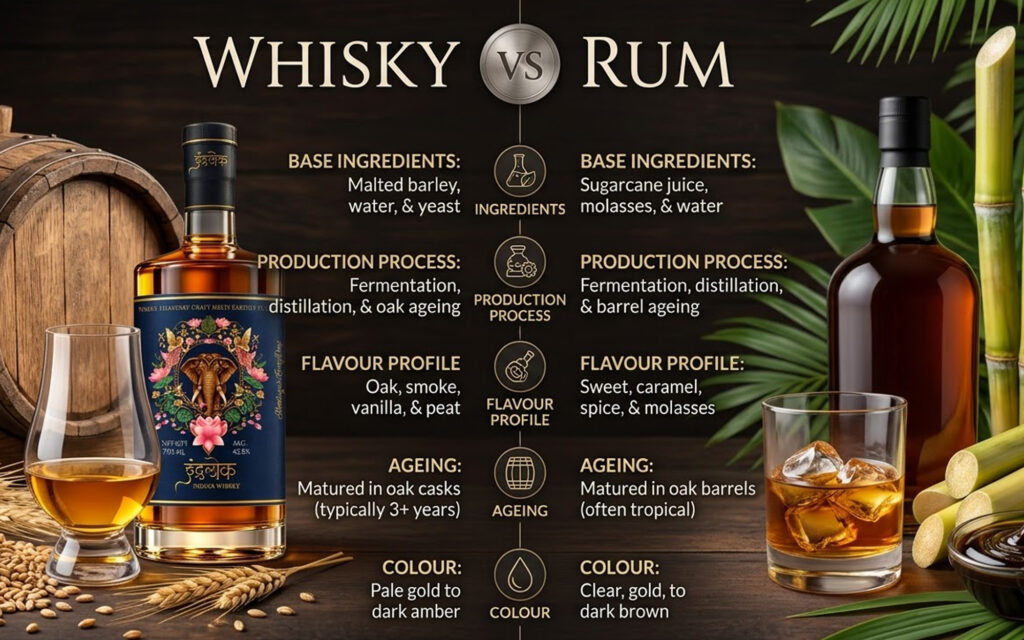
The following table summarizes the main differences between whisky vs rum.
| Feature | Whisky | Rum |
|---|---|---|
| Main raw material | Fermented grain mash | Sugarcane juice or molasses |
| Main sugar source | Sugars converted from grain starch | Naturally available sugars in sugarcane materials |
| Fermentation | Fermented grain-based liquid | Fermented sugarcane-based liquid |
| Distillation | Pot stills, column stills, or other permitted methods | Pot stills, column stills, or other permitted methods |
| Aging | Commonly matured in wooden casks | May be aged or matured in wooden casks |
| Typical flavor notes | Malt, oak, spice, fruit, vanilla, or smoke | Molasses, caramel, tropical fruit, vanilla, or spice |
| Color | Clear before maturation; often golden or amber after aging | Clear before maturation; may be golden or dark after aging |
| Common styles | Single malt, blended, bourbon, and rye | White, gold, dark, spiced, and aged |
| Alcohol strength | Varies by product and market | Varies by product and market |
| Common uses | Sipping, cocktails, and mixed drinks | Sipping, cocktails, and mixed drinks |
Although these differences provide a useful starting point, production rules vary across countries and spirit categories. Therefore, individual products may not fit every generalization in the table.
1. Whisky vs Rum: Difference in Ingredients
The first and foremost difference between whisky vs rum is the type of ingredient used to make each beverage.
Ingredients Used in Whisky
Distillers employ grains like barley, corn, rye, and wheat for the production of whisky. However, different types of whisky require different grain blends.
For instance, malt whisky uses malted barley while bourbon requires a blend of grains, of which at least 51% is corn. Rye whiskies use more rye depending upon the local definition of the spirit.
During production, enzymes convert grain starch into fermentable sugars, and yeast then ferments those sugars into alcohol.
Components of Rum
Ingredients for rum include sugarcane products such as molasses or sugarcane juice. Molasses is a product of sugar extraction, while sugarcane juice is extracted from sugarcane itself.
Since these ingredients have fermentable sugars in them, it becomes unnecessary for producers to engage in the same conversion process that is required in the production of whisky made from grains. Fermentation takes place after producers get their sugarcane ingredient ready.
Eventually, it becomes one of the causes for the difference in flavors between whiskey and rum. However, fermentation, distillation, and aging also play their part.
2. Whisky vs. Rum: The Process of Their Production
Producers make both beverages using similar fermentation and distillation methods. But there are still differences between their manufacturing processes since the raw material used for both beverages contains different fermentable elements.
The Process of Making Whisky
- Grain preparation: The manufacturer selects and prepares the ingredients.
- Mashing: The manufacturer uses water/enzyme to convert starch into fermentable sugars.
- Fermentation: Sugar is converted into alcohol because of yeast, giving flavor and odor.
- Distillation: Producers distil the fermented liquid to concentrate the alcohol and develop the desired characteristics.
- Maturation: When the category requires maturation, producers age the spirit in wooden barrels, where it develops colour, aroma, and flavour.
- Blending/bottling: The manufacturer blends the whisky, adjusts its alcohol concentration as permitted, and prepares it for bottling.
The whisky-making process differs depending on the type of whisky. For instance, Scotch whisky follows specific production and maturation requirements, while other countries use different production methods.
Rum Production Process
- Choosing raw material: Producers select molasses, sugarcane juice, or other approved sugarcane products.
- Processing and preparation: Producers prepare the raw material for fermentation.
- Fermentation: Yeasts convert the available sugars into alcohol and generate flavors.
- Distillation: Producers use distillation techniques to concentrate alcohol in the product.
- Maturation or finishing: Producers can age the beverage in wooden barrels or release it without aging.
- Blending and bottling: Producers blend selected batches and release them to the market.
Despite the similarities in processes, the choice of raw material and techniques leads to various results. Moreover, the length of the fermentation process, type of yeast, distillation still, and maturation barrel have an impact on the flavor.
3. Whisky vs Rum: Difference of Taste and Flavor
Taste is one of the easiest-to-notice differences between whisky vs rum. Nonetheless, none of the two spirits has a standard taste.
Whisky’s Flavors: What Does Whisky Taste Like?
Whisky tastes different depending on its style and type. Common flavours include the following:
- Grain, malted
- Honey, vanilla
- Oak, baking spices
- Apple, pear, dried fruits
- Toasted, caramel
- Smoke, earthy in some styles
For instance, a light-matured grain whisky would taste soft and sweet, while a peated malt whisky might have a strong smoky taste. The same applies to bourbon whisky, which would have vanilla and caramel flavors.
What Flavor Profile Do Rums Possess?
Some flavors of rum may include:
- Molasses and brown sugar
- Caramel and vanilla
- Bananas and tropical fruits
- Spices used in baking
- Oak and dried fruits
- Sugarcane in some types of rums
While younger rums may have a somewhat delicate flavor profile, aged rums may possess a more complicated flavor profile with notes of oak and spices. The spiced rum may also have other flavoring elements in order to change its flavor profile.
Which Spirit is More Sweet?
Rum is usually linked to sugarcane, caramel, and molasses. However, it does not mean that all rum will be sweeter than all whisky.
Whiskies can have flavors of honey, caramel, vanilla, and even fruits. Besides, sweetness detected by smell and flavor does not mean at all that there is much sugar left in a spirit.
Thus, you should compare specific varieties rather than the spirits themselves.
4. Comparison between Whisky and Rum—Alcohol Content and ABV
ABV stands for alcohol by volume and measures the proportion of alcohol in a beverage.
Whisky vs rum are both distilled drinks, and their alcohol contents will vary according to product, process used, and the market. However, most of the standard bottles have about 40% ABV content, but there are cases where the products have different percentages.
This means that a bottle with 40% ABV will contain 40 milliliters of alcohol content per 100 ml of the mixture, while 45% ABV will have a higher alcohol content percentage compared to 40%.
But then, just the name will not be enough to know the percentage. Always check the label.
Does Whisky Contain Higher Alcohol Content than Rum?
Not always. If a whisky has an ABV of 40%, it is the same as a rum with 40% ABV. On the other hand, a rum with an ABV of 45% has a higher content of alcohol than a whisky with 40% ABV.
It depends on the ABV and volume of drinks served. Mixers may also alter the strength of a cocktail, but they will not eliminate the existing content of alcohol.
Alcohol impacts health and decisions. Thus, any type of alcohol beverage cannot be regarded as safe and healthy. People who are not used to drinking should never start due to any health reasons.
5. Comparison Between Whisky and Rum Regarding Color/Appearance
Whisky vs rum can be clear, gold, amber, or dark depending on the type of spirits and how they were made.
Fermented spirits start clear, but barrel wood can change their color and add flavor compounds during maturation. However, producers may use other permitted methods to achieve the desired colour.
Whisky Colour
A number of aged whiskies possess gold, amber, or even brown hues. Cask selection, maturation methods, and permitted colouring processes determine these colours.
However, darker-colored whiskies do not necessarily mean they are older and more valuable. The history of a cask and other production techniques can be responsible for a particular colour.
Rum Colour
White rum is clear, whereas gold and dark rum have darker hues. Producers can achieve these colours through maturation, filtering, blending, or other permitted processes.
Thus, the colour of rum cannot tell you whether it was aged and how long it was kept in a barrel.
6. Whisky and Rum: Aging and Maturation
Both maturation and aging affect rum and whisky, but the requirements for these processes vary depending on the type and country.
Whisky Maturation
Many whisky categories require producers to mature the spirit in wooden barrels during production. In this way, the alcohol interacts with the wood and gains new aromas, colours and flavors.
The casks give the whisky notes of vanilla, oak, spices, and toastiness. Also, maturation can affect the texture and balance of flavors.
Different whiskies require different maturation periods. For example, Scotch whisky should mature in oak barrels in Scotland for at least three years.
Aging of Rum
Rum manufacturers have two options. Firstly, they may choose to sell rum straight away, without ageing. Alternatively, the producers might decide to age rum in wooden barrels. During ageing, the spirit can develop flavours of caramel, vanilla, oak, dried fruit, and spices.
Various factors will affect the outcome. The climate of the region where rum is aged, the type of barrel used, and the duration of the process itself may be important.
However, remember that whisky does not necessarily require more aging time than rum.
7. Whisky versus Rum: Common Sipping Methods
People can use both whisky and rum in cocktails, mixed drinks, or tasting pours, depending on the style. The most popular methods of serving will depend on the spirit flavor and the recipe.
Common Whisky Sipping Methods
- Serve whisky: neat without adding water or ice.
- Whisky on the rocks: served with ice cubes.
- Whisky with water: addition of a drop of water affects the aroma of the drink.
- Whisky highball: whisking with soda water over ice.
- Old Fashioned: a classic cocktail based on whiskies, sugar, bitters, and ice.
Common Rum Sipping Methods
- Rum neat: a popular method for discovering aged rum character.
- Rum and soda: mixing rum with soda water.
- Rum and cola: a popular cocktail.
- Mojito: a cocktail based on rum, lime, mint, sugar, and soda water.
- Daiquiri: a classic cocktail based on rum, lime juice, and sugar.
It all depends on the particular style and type of drink you wish to prepare. For example, Serve aged spirits simply to appreciate their distinctive flavours.
8. Whisky vs Rum: Price and Value
The price of whisky and rum varies depending on factors such as producer, raw materials, cost of production, maturation, packaging, taxation, and distribution, among others.
Some lower-level bottles of the two spirits may be cheaper compared to some premium brands. Other elements that may cause the price of whisky and rum to be high include long maturation process, unique method of production, and foreign packaging among others.
In India, the policy of the state regarding excise and retailing can determine the price of whisky and rum. Therefore, you will find the price varying from one state or city to another in India.
It is not right to assume that whisky will always be expensive compared to rum. When comparing whisky and rum, ensure that you choose items that are in the same market and have the same size. Compare the alcohol by volume, category, age and any other information indicated on the label.
9. Whisky vs Rum—Which is Better?
The debate between the two has not come to an end yet. Whisky and rum have several types, and which one is better all comes down to tastes and uses.
Why You Might Like Whisky
If you are someone who likes flavors that derive from grains, spice, oak, or malts, you might like whisky. Besides, there are different types of whisky; you have blended and bourbon whisky.
Furthermore, whiskies can also make great classic cocktails or tasting spirits. Nonetheless, there is a lot of variation in the flavor of each bottle.
When You Might Find Rum Interesting
The rum may be interesting for those who like sugarcane-based qualities, molasses, caramel, fruits, or spices from the tropics. There are various types of rum, which allows you to use it for cocktails or for tasting aged rum.
Moreover, the aromas of rum depend on ingredients, fermentation, and the aging process. Therefore, try different rum styles instead of judging the entire category by one bottle.
How Should You Compare Them?
First, take a look at the label and learn about the style of the product. Then, pay attention to the flavor profiles, ABV, serving style, and price.
If you are comparing the spirits for the first time, do not think that one of them is automatically smoother or better.
10. Whisky vs Rum in India: A Key Distinction
In India, spirit categorization and manufacturing processes need special focus. Some of the products manufactured for the Indian market may use techniques different from the typical definition of whiskies and rums based on their production from grains and sugar canes, respectively.
Some of the products in the Indian spirit market may contain extra-neutral alcohol and blended spirits, based on their classification according to Indian regulations. Indian regulations classify these products according to applicable legal standards and manufacturing requirements.
Thus, it cannot be assumed that all the bottles available as Indian whiskies use spirit produced from grains only, nor all rum products follow the same process of manufacturing as the rum globally.
Consumers should read each product’s ingredient list and label to understand its characteristics and applicable classification. It would help the reader to compare the products better.
Frequent Misunderstandings Regarding Whisky & Rum
Misunderstandings may sometimes make it easier to comprehend distinctions between whisky and rum.
Myth 1: Rum Will Always Be Sweet Compared to Whisky
The flavor of rum can include hints of caramel, molasses, and sugarcane. Whisky, too, can have a sweet taste due to its grain composition and flavors from the barrel. In any case, this is the end result of the product.
Myth 2: If It Is Dark, Then It Is Older
The color cannot tell you about the age. Cask aging and other legitimate production techniques can affect the look. The verified age of the product should be looked for instead.
Myth 3: Whisky Has More Alcohol
The amount of alcohol will differ in both groups. Just compare the actual label of the products.
Myth 4: Rum Is Good Only for Cocktails
While some rums can be used in cocktails, others such as aged rums are taken straight or mixed with water. Whisky is also the same.
Myth 5: The More Expensive Spirits Are the Best Spirits
Price involves a lot of things like production, bottling, taxation, and delivery cost. Just because it is an expensive spirit does not mean that it will be liked by everyone.
FAQ Whisky vs Rum Comparison
Q1. What are the main differences between whisky and rum?
The one difference lies in the raw material. Unlike whisky that is made using the grain mash, rum is usually produced using sugarcane or molasses. The manufacturing process will determine the taste and color of the spirit.
Q2. Is whisky stronger than rum?
No. The strength of the drinks depends on the ABV percentage indicated in the bottle.
Q3. Do the tastes of whisky and rum differ?
Yes, they do. But there is similarity in the tastes. Whiskies have tastes of malt, wood, spices, fruit, and smoke. Rum has the tastes of molasses, caramel, fruits, and spices.
Q4. Is rum derived from sugarcane?
Yes. Producers usually make rum by fermenting sugarcane juice or molasses and then distilling the fermented liquid. After distillation, producers either age the spirit in wooden barrels or bottle it directly.
Q5. Are all types of whiskies aged in wooden barrels?
It differs according to the type and region; however, most types of whisky have the requirement of aging in wooden barrels. In the case of Scotch whisky, it needs to age for three years in oak barrels in Scotland.
Q6. Can we use whisky and rum for cocktails together?
Yes. Both types of alcohol can be used in cocktails; bartenders use whisky to make cocktails such as the Old Fashioned and Whisky Highball, while they use rum for cocktails such as the Mojito and Daiquiri.
Q7. Why do some rums appear darker in colour than some whiskies?
Rum may become darker due to maturation in barrels or any other legal processes used for its manufacturing. Also, whisky varies in colour from light yellow to dark amber. Thus, colour cannot indicate whether the spirit is aged or of good quality.
Q8. Is it true that whisky is generally more expensive than rum?
No, one of the alcoholic beverages is not always more expensive. It depends on the brand, way of making, maturation, bottle volume and taxes. You should compare drinks available in the same market.
Q9. What should I look for before making a comparison of whisky vs rum?
Check the drink’s category, raw materials, ABV, age or maturation statements, bottle size, and price. Moreover, pay attention to the taste description and serving method.
Q10. Is the process of production the same for whisky and rum?
Generally speaking, fermentation and distillation form the basis of the processes. But producers of whisky deal with grain material and rum producers with sugarcane material. Other aspects can also differ between the two.
Conclusion: Distinction Between Whisky and Rum
The whisky vs rum comparison begins with the ingredients of these spirits: the former uses fermented grains, while the latter uses sugarcane juice or molasses. But there are other features that distinguish them from each other.
For example, whisky can have flavors of malt, oak, spices, fruits, and smoke. And in turn, rum can have flavors of molasses, caramel, vanilla, tropical fruits, and spices. However, no alcohol is homogeneous, and each method of production counts much.
If you compare bottles, pay attention to the label, the alcohol content, and to which category the product belongs. In India, it is especially necessary to consider the information of the producer.
This all becomes important when you start assessing each type. Pay attention to product information and the production facts about the particular bottle itself rather than making assumptions that one is automatically better than another.
Remember to drink responsibly. Alcohol can be dangerous for your health.