Whisky vs Vodka: What’s the Difference? A Complete Guide
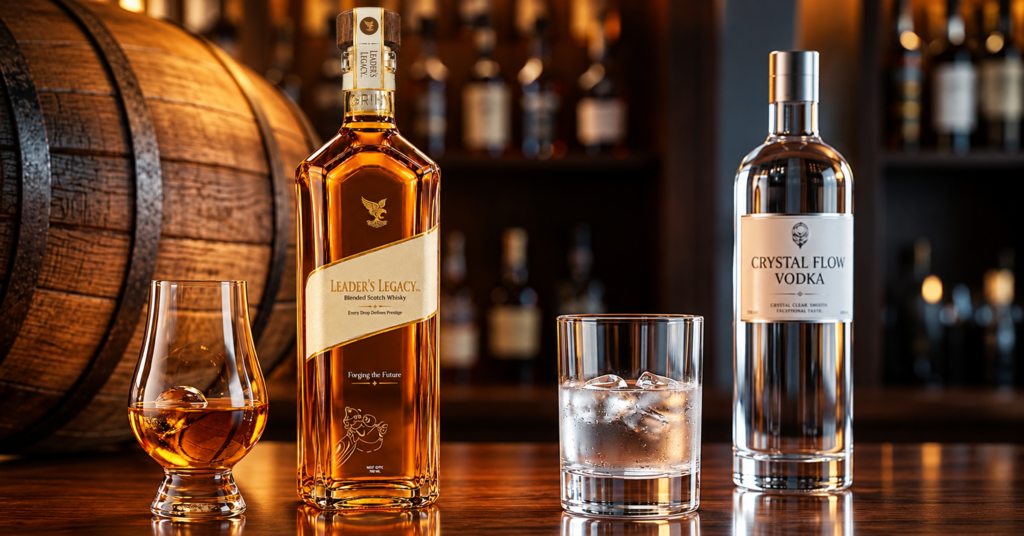
When we compare whisky vs vodka, despite the fact that these two types of alcoholic drinks might be very different at first glance, both have one similarity—they are distilled. Nonetheless, the ingredients, methods of manufacture, process of distillation, taste, color, and maturing make these spirits quite different when it comes to consumption.
Grains, fermentation, distillation, and aging normally give whisky its unique taste. Producers make vodka to achieve a clean and neutral taste. Thus, it is clear that the difference between these types of alcohol cannot be found only in color and taste.
However, what are the differences?
What is whisky?
Producers distill whisky from fermented grain mash. Producers use grains such as barley, corn, rye, and wheat to make different types of whisky.
First, producers prepare the grain and turn its starch into fermentable sugars. Second, yeast ferments the sugars into alcohol. And third, the fermented liquid is distilled.
But the whisky production doesn’t stop there. Producers age some types of whisky in wooden barrels, where the spirit develops new flavors, aromas, and colors. Thus, different types of whisky have flavors ranging from vanilla and caramel to spices, fruits, oak, or smokiness.
Definition of Vodka
Producers distill vodka to create its clear appearance and neutral taste profile. There are various types of materials that may serve as fermentable agents for the production of vodkas; those include grains and potatoes.
The first step is the fermentation process. Then producers distill the fermented product to create a strong, neutral alcohol. Then producers filter the spirit and add water to achieve the required alcohol content.
Producers usually make vodka as a neutral spirit, so people can use it in cocktails and mixed drinks. At the same time, there are some brands of vodkas which have a distinct taste due to their ingredients, water content, distillation and filtration.
Whisky vs Vodka: Key Differences at a Glance
| Feature | Whisky | Vodka |
|---|---|---|
| Main base | Grains | Grains, potatoes, and other fermentable materials |
| Appearance | Usually amber to deep brown, depending on style | Usually clear |
| Flavor | Often rich, complex, and distinctive | Usually clean and neutral |
| Distillation | Designed to retain character | Often designed to achieve greater neutrality |
| Aging | Many traditional styles mature in wooden casks. | Generally not aged in wooden casks |
| Barrel influence | Common in many whisky styles | Usually absent |
| Common serving | Neat, with water, or over ice | Neat, chilled, or in cocktails |
| Cocktail role | Used in many classic and modern cocktails | Widely used as a cocktail base |
These differences provide a quick overview. However, the details become clearer when we look at how each spirit is made.
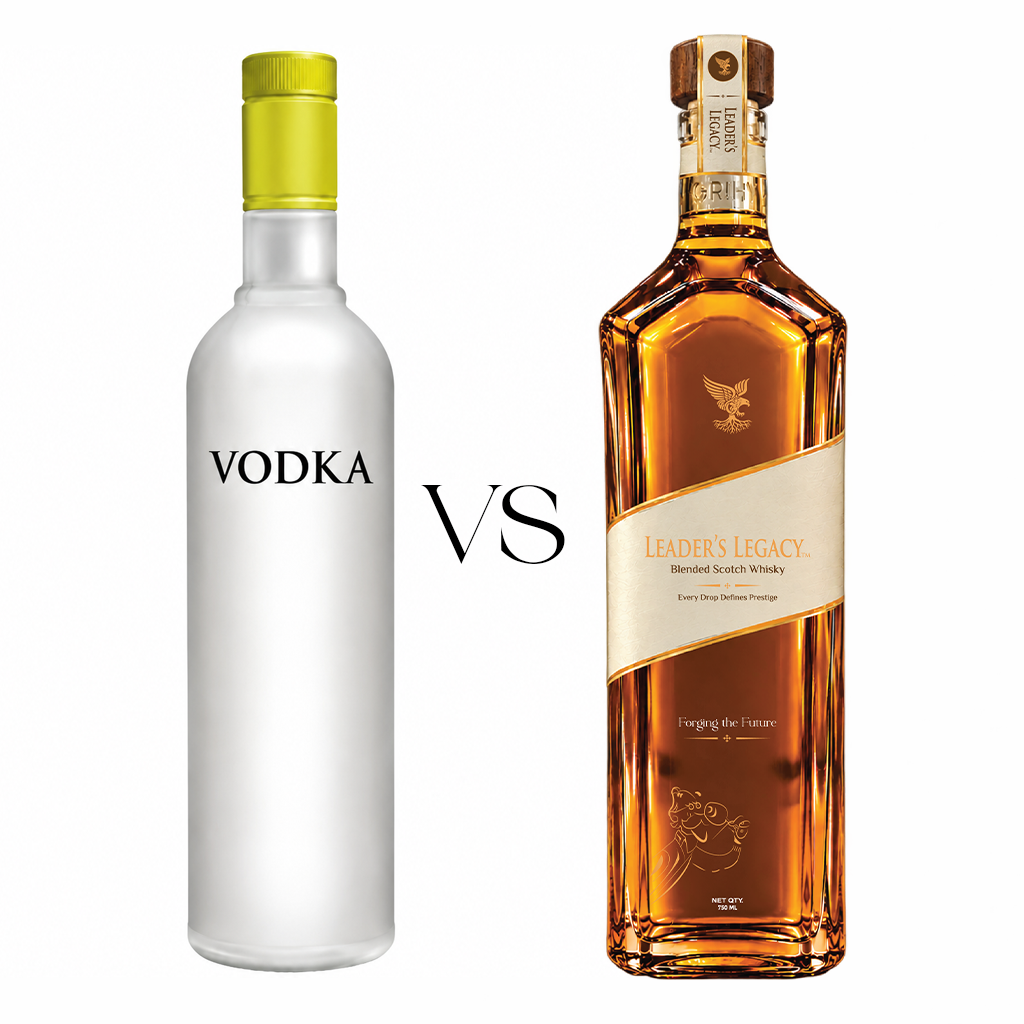
Difference Between Whisky & Vodka—How do we produce them?
Both drinks include fermentation and distillation, but producers use these processes differently to achieve the desired result.
How is Whisky Produced?
Whisky production involves the following stages:
- Grain preparation—Grains are selected and prepared by the producer.
- Mashing—The producer mixes grains with water to make starch into sugar.
- Fermentation—Yeast turns sugars into alcohol.
- Distillation—Distillation concentrates the alcohol.
- Maturation – Various kinds of whisky mature in wooden barrels.
- Blending/finishing—Some producers blend or finish the drink according to its type.
- Bottling—Finally, it is time for bottling the drink.
Process of Making Vodka
The process of making vodka involves a different production philosophy:
- Selection of the raw material—the producers select the fermentable raw material that is suitable.
- Preparation or mashing—The producers prepare the starchy material for fermentation.
- Fermentation—the yeast changes the sugars into alcohol.
- Distillation—Producers distill the alcohol to create highly refined vodka.
- Filtering—Some producers filter the vodka to make it more refined.
- Water adding—Producers add water to the vodka to reach the desired bottling strength.
Whisky vs Vodka
Hence, the whisky vs vodka process involves two different philosophies: whisky emphasizes character whereas vodka emphasizes neutrality.
Ingredients
Ingredients become an important distinction.
Whisky needs grains that include barley, corn, rye, or wheat. The selection of grains will affect the resulting product in some way. Different grains will have different effects on the aroma, texture, and taste of the beverage.
The ingredient of vodka could be grains. But the manufacturers could opt for potatoes or some other fermentable crops.
Thus, both beverages can start from the same grain, but much depends on the entire process besides the initial ingredient.
In What Way Does the Distillation Process Differ?
Distillation is among the key stages in the process of making spirits.
When producers distill a spirit, they separate different elements of the liquid according to their volatility. Producers can use different distillation methods to control the flavours that remain in the final product.
When making whisky, producers usually preserve enough grain and fermentation character to give the spirit a distinctive profile. There is no single distillation process for whisky.
The distillation of vodka involves more intensive purification and/or rectification of the initial mixture. High-purity distillation can remove many flavor compounds. After this, producers may refine the spirit through filtration and carefully selected water.
Thus, the philosophy of the distillation process explains the difference in the character of spirits.
Whisky vs Vodka – Which One Contains Higher Alcohol Content?
There is always a general belief that there will always be one spirit that contains higher alcohol content. But that may not be the case.
The spirit type and its alcohol by volume determine the amount of alcohol in a bottle. Both vodka and whisky, when compared, usually have an alcohol content of about 40%, even though different spirits may have different levels of alcohol content. According to FSSAI reference material, whisky is generally found at 40–50% ABV, and vodka at 40% ABV.
Therefore, it is important to look at the ABV indicated on the spirit bottle and not the taste, color, or type of spirit.
A whisky can taste warm without having more alcohol content. Similarly, vodka can have the same alcohol content level as whisky.
Difference between Whisky and Vodka: How Are Their Tastes Different?
Taste is where the difference is most noticeable for many consumers.
Whiskies usually have a much more extensive palate. The taste of whiskies depends on the type and may include tastes of grains, oak, vanilla, caramel, fruits, spices, smoke, etc. Maturation can also add new flavours because the spirit interacts with wood.
Vodka is usually much more neutral in its taste; however, some types of vodka may be a little bit sweet, have tastes of grains or minerals, or creamy texture.
To put it simply, whiskies are more about character and complexity, whereas vodkas are more about cleanliness and neutrality.
Why Is Most Whisky More Colored Than Vodka?
It is quite apparent.
Most traditional whisky develops its colour during ageing in wooden barrels. Slowly, the spirit absorbs colour and flavour from the wood
Vodka usually remains colorless because producers generally do not age it in wooden barrels.
What is crucial to understand is that the coloring of the spirit does not necessarily mean that everything about it can be determined. Different spirits are made using various methods and according to various regulations.
Whisky VS Vodka: Importance of Ageing
The age may be important for whisky but not for vodka.
Most types of whisky are aged in wooden barrels for a certain amount of time. During this process, the spirit interacts with wood and undergoes chemical reactions that may affect its aroma, appearance, taste, and texture.
Vodka does not necessarily require this ageing process. What is most important is distillation, filtering, and the quality of water used.
So, ageing may be considered a crucial element in whisky production technique, while vodka does not necessarily need it.
Whisky & Vodka: How Are They Served?
The serving method distinguishes between the two types of liquor as well.
People usually enjoy whisky:
- Neat
- Mixed with a few drops of water
- On ice
- In whisky cocktails
This helps the consumer experiment with various smells and flavors.
Vodka is usually consumed:
- Chilled
- On ice
- In mixes
- In cocktails
Due to its neutral nature, vodka mixes very well with a variety of ingredients, for example, citrus, tonic, fruit flavorings, and others.
Still, neither of the types have one right way of consumption. Individual preference, type of bottle, and circumstances play their role.
Whisky vs Vodka—Which One Is Smoother?
The term “smooth” has a number of meanings for different individuals.
Some drinkers call vodka smooth because its neutral nature and filtration create a clean drinking experience. Others call high-quality whisky smooth because of its balanced alcohol content, texture, taste, and finish.
In light of this, you should not assume that smoothness is something measurable technically.
There are various factors, including
- Alcohol level
- Texture
- Flavor level
- Distillation process
- Filtration process
- Aging process
- Service temperature
Thus, the smoothness of any bottle of spirit is dependent on the bottle itself rather than on whether it is a whisky or vodka.
Comparing Whisky and Vodka: Which is More Suitable for Cocktails?
Bartenders can use both spirits to make great cocktails, but each one creates a different result.
First, vodka is quite a neutral base spirit. This means that mixers and other ingredients can be the key ingredient of the drink.
Second, whisky gives its own flavor to the cocktail. That is why, one can taste some elements of whisky along with bitters, citrus, sugar, herbs, or any other mixers.
Third, bartenders often use vodka to make cocktails such as the Moscow Mule and Cosmopolitan. Meanwhile, bartenders make cocktails such as the Old Fashioned and Whisky Sour with whisky.
So, it all depends on the type of cocktail and the desired flavor profile.
Whisky vs Vodka: Which One to Go for?
One cannot give a general recommendation since there are differences in their attributes.
Go for whisky if you are after:
- Deeper taste
- Grain
- Oak
- Maturation notes
- Sipping it plain or over ice
It may be better to choose vodka if you like:
- Clean taste
- Neutral flavor
- Cold sipping
- Mixing the drink
- The cocktail when
- other ingredients shine
In the end, it all depends on individual preferences and the kind of drink you like.
Difference Between Whisky and Vodka—Key Distinction Revealed!
The primary distinction between whisky and vodka lies in their aims of production and character retention.
Namely, Whisky production typically retains grain character and develops more flavour through distillation and ageing in wooden barrels. Vodka usually aims at producing a clear, very refined, and rather neutral drink.
However, there might be differences in ingredients used, distillation process, color, flavor, ageing, and even serving methods. Still, they are all distilled beverages and can have some individual features depending on each particular product.
Thus, it makes sense to stop asking about which drink is definitely better than the other and try to find out what you want from your beverage. If complex flavors with an oak impact are of your liking, go for the whisky. If you want a clean base for cold serves and cocktails, choose vodka.
Frequently Asked Questions About Whisky vs Vodka
Q1. What is the main distinction between whisky and vodka?
The key difference consists in the way they are manufactured. Producers make whisky from grain and age it in wooden barrels to develop its flavour. Vodka, on the contrary, is made to be neutral.
Q2. Is whisky stronger than vodka?
No, it isn’t. The ABV of each bottle determines its strength. There are strong and weak whiskies and vodkas. For example, they contain 40% ABV, and there are also more powerful types of alcohol.
Q3. Does vodka include wheat like whisky?
Producers may make vodka from wheat or other grains. Potatoes are also used for making vodka. Whisky is always made using grain.
Q4. Why do whiskey become brown-colored and vodka remain clear?
Because of the maturing process mainly. Whisky develops its color while producers mature it in wooden barrels. Producers generally do not mature vodka in wooden barrels, so it usually remains clear.
Q5. Can we mix whiskey and vodka together?
Yes, we can use both of them for making cocktails. However, mixing them will increase the cocktail’s total alcohol content and affect its strength.