Whisky Price in India 2026: Bottle Sizes, State-Wise Rates & Buying Guide
The price of whisky in India depends upon the brand, volume of the bottle, classification of the whisky, the state excise, and the rules that govern the retailing in the locality. Thus, two bottles having similar sizes may cost differently depending on where the consumers buy them from different cities. Besides, excise policy changes during the year may influence retailing prices as well.
There are value-for-money Indian whiskies, premium blends, Indian single malts, and Scotch whiskies for Indians to pick from. However, the comparison of such beverages cannot be done only by looking at their prices posted online. Bottle volume, alcohol content, product category, and maximum retail price (MRP) have to be considered as well.
This guide provides information about the whisky pricing in India in 2026. Also, it contains the details regarding typical bottle volumes, state-specific prices, major factors affecting the pricing, and practical means of price verification. Due to the possible changes in the state policies and brand prices, always check the most recent MRP in person.
1. What Makes Whisky Priced in India?
There are many considerations that affect the price of whisky in India. While it is true that brand names attract attention, there are other considerations that lead to the price of the product.
Positioning of the brand: Brands can be positioned as value, standard, premium, or luxury. As a result, their pricing is going to vary.
Category of whisky: Indian blended whisky, Indian single malt, and Scotch whisky have distinct production and marketing considerations. As a result, their pricing cannot be compared.
Bottle volume: Though the 180ml bottle of whisky is cheaper than the 750 ml bottle initially, there might be possibilities where the latter one is value per ml.
State Excise Policy: States have the right to charge the excise duty, fee, and many other rules. As such, the same whisky will have different MRP in different states.
Production and distribution: Production process, including ingredients, maturing, packing, delivery, etc., may influence the price.
Market changes: Both manufacturers and states may make a change in prices anytime during the year. Consequently, the online price list may not provide accurate price information for today.
In brief, buyers need to compare the same whisky variant and volume in the concerned state market.
2. Whisky Price in India by Bottle Size
Bottle capacity is one of the easiest ways to organize whisky prices. However, the actual MRP depends on the specific product and location.
| Bottle size | Common description | What to check |
|---|---|---|
| 90 ml | Small pack, where available | Current local availability and MRP |
| 180 ml | Small bottle or quarter | Variant, packaging, and state price |
| 375 ml | Half-size bottle | MRP and price per milliliter |
| 750 ml | Standard bottle size | Current MRP for the exact variant |
| 1 liter | Larger bottle, where available | Availability and price per milliliter |
Whisky price for 180 ml
Whisky available in a 180 ml bottle is cheaper to buy than a bigger bottle of the same product initially. But this may differ depending on the particular brand and regional laws. Hence, be sure to look at the specific variant for a fair comparison of prices.
Whisky price for 375 ml
A 375 ml bottle of whisky is located between smaller packages and the usual 750 ml. Thus, it can help consumers compare various packages without buying a big one.
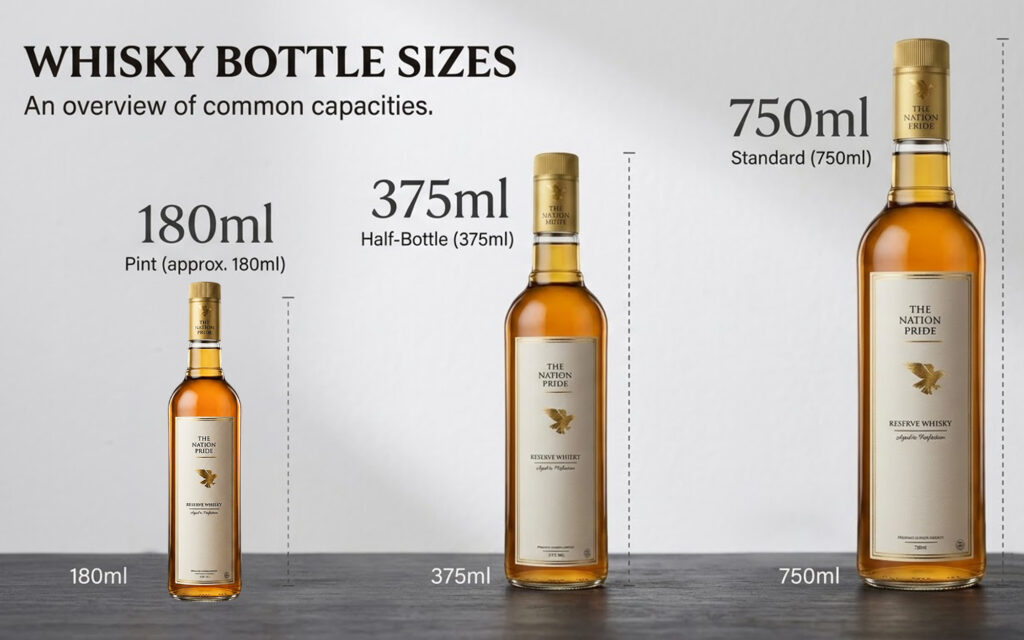
Whisky price for 750 ml
The 750 ml bottle of whisky is common when comparing prices of whisky. But a fair comparison needs to specify the brand, variant, region and actual MRP price.
Price of 1-liter whisky bottle
Some brands and places have 1-liter capacity whisky bottles. Despite the initial high price of a larger bottle compared to a small one, the price per milliliter can be relatively lower. But this is not always the case; thus, the price must be compared to make conclusions.
3. Indian Whisky Prices State-Wise 2026
The price of whisky in India is not based on any national retail price list for each bottle. The price paid by consumers is affected by state-wise excise policies, duties, distribution, and retail regulations.
The below table shows you how to check the prices.
| State or market | What to verify before comparing prices |
|---|---|
| Uttar Pradesh | Current state-approved MRP and the exact whisky variant |
| Delhi | Current approved retail price and applicable product listing |
| Haryana | Current state price list and bottle capacity |
| Punjab | Applicable MRP and local retail availability |
| Rajasthan | Current excise-approved product price |
| Maharashtra | Latest applicable MRP and retail price information |
| Karnataka | Revised price information under the current excise structure |
| Goa | Current product MRP and local availability |
| West Bengal | Applicable state price list and product details |
| Telangana | Current approved price and product availability |
Important: This table does not claim that any state offers the lowest whisky prices. Actual prices depend on the product and the applicable rules at the time of purchase.
How to ascertain the most recent price of whisky on a state basis
The first step is identifying the name of the brand and its variant. Secondly, ascertaining the size of the bottle and finding out the most recent official state excise or approved price. Thirdly, comparing it with the MRP mentioned on the bottle at a licensed seller.
Also, find out the publication date of the most recent price list if available online. If the source does not mention the date, product variant, and state, do not consider the price mentioned as authentic.
4. Factors Leading to Variations in Prices of Whisky Across Different Indian States
The variation in prices within the states occurs due to several factors. For example, there is no state pricing mechanism that applies to all forms of alcoholic drinks in India.
- Excise taxes and levies: There is a difference in the type of taxes and levies that apply to different states. Therefore, changes in the policies will affect the pricing mechanisms for the different types of liquor.
- Distribution: The process of storage, transportation, distribution, and sale can influence the prices.
- Approval of prices: Some states have a system of price approval and listing. As such, the price of a product can differ across different states.
- Product category: Various categories of whisky could be subject to different taxations or pricing policies. Therefore, new developments in government policy could affect different products in a distinctive way.
For instance, a price list based on the alcohol content has been made for excise in Karnataka as from May 2026. It is just one more reason to consider local state information instead of using the outdated national price list.
In addition, low price in one area doesn’t always indicate that the same product would have a similar price in another area.
5. Whisky Price Classification in India
Whiskies have several market classifications. These classifications are about positioning rather than specific price ranges.
- Value and standard whiskies
These whiskies usually cater to people who prefer well-known brands and affordable prices. The MRP of such whiskies varies from brand to brand and also by state.
- Premium whiskies
Premium whiskies may highlight different features like their blend, taste, ingredients, manufacturing process, etc. However, premium positioning alone does not determine the quality of a product.
- Indian Single Malt Whisky
Indian single malt whiskies form a unique class within India’s whisky industry. The techniques of production, aging, availability, and branding of these spirits could determine their retail prices.
- Imported Scotch Whisky
Imported Scotch whisky might be subject to extra costs associated with importing, transportation, and duty payment. Hence, the price of imported Scotch whisky could vary significantly from the price of the locally-produced whisky.
It is important to note that no specific price exists for all products in each of these classes. Always refer to the latest information regarding prices of particular products before publication.
6. Indian Whisky vs Imported Whisky: Pricing Variation
There may be differences between Indian whisky and imported whisky in terms of production, origin, categorization, distribution, and marketing. This is why consumers need to make comparisons on equal grounds.
| Comparison factor | Indian whisky | Imported whisky |
|---|---|---|
| Production location | Produced in India, depending on product classification | Produced outside India |
| Price influences | Production costs, state duties, distribution, and positioning | Production costs, import-related costs, applicable duties, and distribution |
| Product categories | Includes different Indian whisky styles | Includes imported Scotch and other whisky categories |
| Availability | Depends on the state and local market. | Depends on import channels and local availability |
| Price comparison | Requires the exact variant and MRP | Requires the exact variant, origin, size, and MRP |
Nevertheless, the country of origin is not the criterion of the drink’s quality. Moreover, the high price cannot serve as a guarantee of the whisky meeting one’s taste expectations.
In order to make a comparison, you need to look at the product’s category, alcohol content, size, and price on the shelf. Additionally, you need to take into account the information about the flavor and manufacturing.
7. Correct Method for Comparing Whisky Price Rates
Systematic comparison helps you analyze the whisky prices systematically. Avoid comparison of any unrelated products and follow these instructions.
- Step 1: Compare the bottle sizes. Either compare 750 ml with 750 ml or find out the price per ml if the bottles have varying capacities.
- Step 2: Compare the same product type. Try to compare the same kind of whiskies wherever possible. E.g., Indian blend whisky cannot be compared to an imported single malt, as they do not belong to the same product range.
- Step 3: Find out the specific variant. The brands often come up with many variants, and each variant has its own specification and MRP. So brand names will not suffice.
- Step 4: Get the current MRP of the whisky. Take into account both the price written on the bottle and the current information from the respective states.
- Step 5: Take into consideration the location. The policy of the respective state could affect the retail price. This implies that the prices in the online world of another state do not matter.
- Step 6: Calculate the price per milliliter. Do this by dividing the price of the item by the quantity of the bottle in milliliters.
For example, the price per milliliter for the hypothetical 750 ml bottle priced at ₹900 will be ₹1.20, while the price per milliliter of the hypothetical 375 ml bottle for ₹500 will be around ₹1.33.
It is only to illustrate, and the real price of no brand of whisky is shown here.
8. Knowledge about MRP and the Whisky Price List
MRP means the maximum retail price. This gives an important point of reference in checking the price of packaged items.
But online whisky price lists may get out-of-date owing to policy changes, revision of prices, and modifications of the product. The reader must confirm the current details of the product and not take for granted that all lists on the Internet are still accurate.
One should first consider before believing in any list the following:
- Publication or last verification date.
- Region or market that the data refers to.
- Brand name and variant of the product.
- Size of the bottle and alcohol content.
- Price source quoted in the article.
- Current MRP stated on the product.
Moreover, readers must know that in articles concerning multiple regions there will be guesses and historic prices. If one does not have confirmation of the current price from some source, then the price is to be marked as such.
9. Common Errors While Comparing Whisky Prices
Both consumers and publishers can fall into some common errors while comparing whisky prices. Luckily, a couple of easy steps can avoid any such comparisons being misleading.
Comparing bottles with different capacities: A 375 ml bottle will definitely cost less than a 750 ml bottle. But this does not mean better value for money.
Ignoring the state: Prices vary from state to state. Hence, if someone quotes a price in Delhi, it might not be applicable for Uttar Pradesh or Karnataka.
Taking outdated information: A piece that was written a long time back will keep coming up on search engines even after its pricing changes. Thus, always use the updated info.
Comparing products in wrong categories: Blended whisky and Single Malt can differ in their method of production as well as market positioning.
On assuming that “expensive” is synonymous with “better”: Price cannot be used to determine either personal preferences or quality of the product. Rather, focus on information about the product as well as on qualities that matter to you.
On trusting information found on websites: The online price shown may be outdated or the information provided about the product may not be complete. Check with the relevant licensed retailers.
10. How to Obtain Accurate Pricing Information about Whisky
Accurate pricing information will help the reader in comparing prices. Besides, accurate sourcing information will make your price guide very valuable.
The first step is to search for the official excise department’s website of the state or any government notification. Make sure to use official price lists of products and the retail information.
Secondly, verify the variant and size of the bottle. In case the official price list doesn’t contain the product, then compare the MRP printed with the one at a licensed retailer.
Lastly, ensure that you write down the date when you have done the verification. This way, the task will become easier next time you need to update the information.
As a website owner, the following should be contained in a useful price table: State, Brand, Variant, Size of bottle, Verifiable MRP, Source, Verification Date.
11. Checklist While Buying Whisky in India
Price comparison cannot be based on the quantity alone. Thus, here is a list to check all the important details regarding the product.
- Ensure that the exact product and variation name match.
- Look at the size of the bottle and the alcohol percentage claimed.
- Check the MRP of the product in your state.
- Buy the product only from a licensed seller.
- Adhere to the legal age limit and other state regulations.
- Ensure that you buy the original product with a genuine label.
Also, keep in mind that there are health risks associated with alcohol consumption.
Frequently Asked Questions About Whisky Price in India
Q1. What is the price of whisky in India in 2026?
There cannot be a single price for the whole of India because of the number of different factors that will affect the quantity, including the brand, type of bottle, state-wise price, and existing MRP.
Q2. What is the price of a 750 ml whisky bottle in India?
Price of 750 ml whisky bottle will differ from the type of the product and the state. Indian blended, Indian single malt, and Scotch whisky can belong to various price ranges.
Q3. Why do different states have different prices for whisky?
Whisky prices in different states can be affected by various factors such as excise duty, fee structure, distribution system, and pricing policy among others. Policy change will also impact different products in a different manner.
Q4. Will a 750 ml bottle of whisky be less expensive per ml compared to a 375 ml bottle of the same?
It might be possible; however, it will depend upon the price. Just divide the MRP by the bottle volume in both cases to make sure which one is cheaper per ml.
Q5. Where should I check the latest price of whisky in my state?
Begin by visiting the respective state excise department’s website or the latest approved price details, if any. Afterwards, get the exact details of the product and its MRP from a licensed retailer near you.
Conclusion: How to Interpret the Whisky Price in India
In order to understand the whisky price in India, there is a need to make comparisons of bottle sizes, categories of products, location, and MRP. Though an online price guide is helpful in gaining insight into the price of a whisky in India, the policies of the states and product prices might vary from time to time during the year.
So, it is recommended to look at the most updated source of information before using any rate quoted in it. Comparisons must be made based on the same bottle sizes; one needs to see the specific variant and the current local pricing information instead of one price for the entire country.
For publishers, the most valuable whisky price guide is one that explains everything along with the dated price information.