Whisky Tasting Notes Explained: How to Identify Aroma, Flavour and Finish
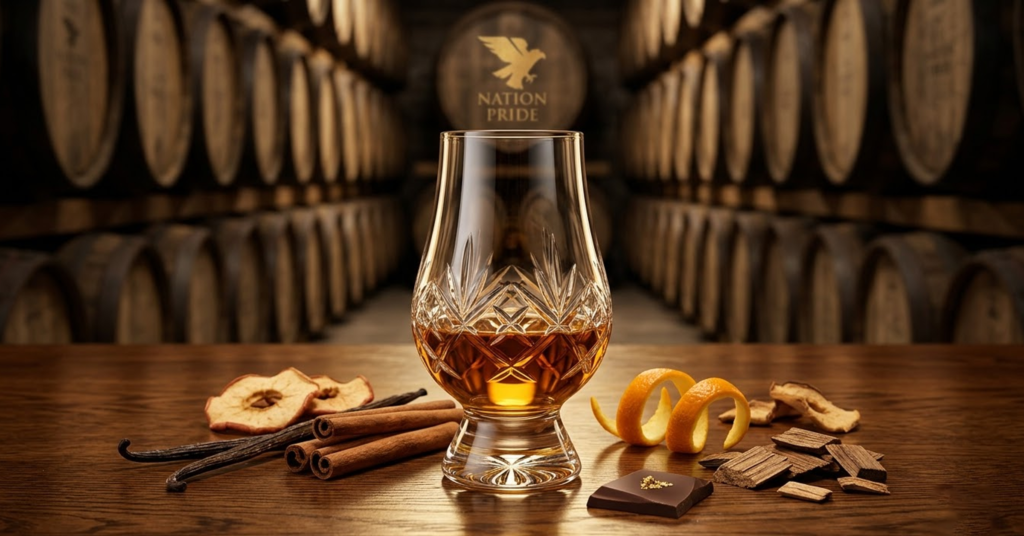
The drink is far more than its particular fragrance and warmth. Each variety can contain a unique blend of such elements as fruitiness, spiciness, sweetness, and woodiness, as well as body. Nevertheless, newcomers usually find it difficult to use such terminology while describing these features. Descriptive whisky tasting notes explained will help you learn about what you smell, what you taste, and what stays on your tongue after each sip. In addition, such knowledge will help you to evaluate different kinds of this drink and form your own preferences.
You will not have to undergo special training in order to start. All you need is patience and a steady technique of tasting. The following guide will help you to learn the meaning of such terms as “tasting notes of whiskies,” “common profiles of flavors,” and “proper description of aroma, flavor, and finish.
What Are Whisky Tasting Notes? Explained
Whisky tasting notes are descriptions of a whisky’s characteristics. With their help, it is possible to characterize its appearance, aroma, taste, mouthfeel, and aftertaste. In this way, you can describe its specific characteristics in detail rather than saying whether it is good, bad, or something else.
For instance, one whisky will be like honey, vanilla, and toasted oak. The other whisky will evoke flavors of dried fruits, cinnamon, and dark chocolate. In addition, there will be earthy notes in the smoky expression with a roasted taste.
This description does not imply the evaluation of quality. On the contrary, they allow describing what a particular person tasted in a specific whisky.
Moreover, tasting notes make it possible to compare bottles. They are useful while trying different styles of whisky or selecting a suitable bottle according to your personal preferences.
The Three Key Components of Whisky Tasting Notes
Tasting notes of whisky usually involve the following three basic components: aroma, palate, and finish. Each component is associated with a certain stage of the tasting process.
1. Aroma: How does the whisky smell?
The term “aroma” stands for scents that can be identified by sniffing at the glass. Whisky can possess fruity, floral, sweet, spicy, woody, or smoky scents.
In particular, one can identify such aromas as fresh apple, orange skin, honey, vanilla, cinnamon, or toasty wood. In some cases, one can also find dried fruits, roasted nuts, or earthy tones.
It is important to start with the most pronounced scents, not trying to define all the available aromas. One should make a small break and smell the whisky again to see if there are other scents.
2. Palate: How Is the Whisky Tasting?
The palate includes tastes and sensations that one gets while tasting the whisky. Sweetness, bitterness, sourness, and many other senses are included here.
You can taste caramel, malt, citruses, spices, chocolate, and dried fruits. Moreover, the whisky can be creamy, oily, light and drying in the mouth.
The strength of alcohol in the drink can affect the sensation as well. Thus, it is important to distinguish between the warmth of alcohol and other tastes.
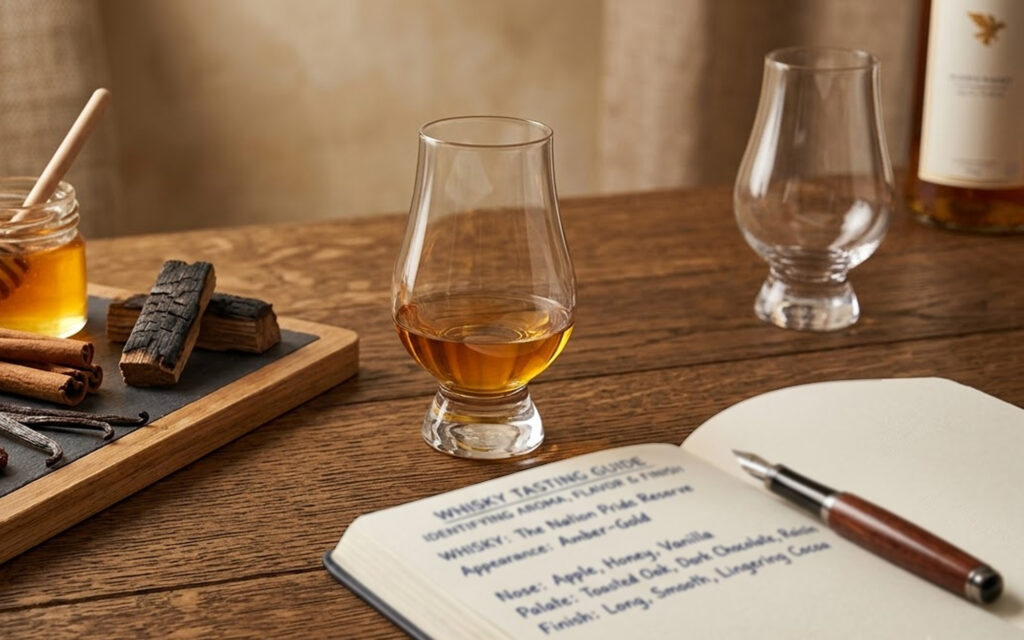
3. Finish: What Is Left Behind After the Sip?
Finish includes the tastes and sensations that appear after the consumption of a small portion of the whisky. There are those whiskies that leave no aftertaste at all and those whiskies whose aftertaste lingers for a very long time.
Thus, the whisky can be sweet on the finish, warm because of spices, oaky and smoky. Moreover, the tastes can change gradually during the finish period.
But it should be understood that the long finish does not necessarily mean that the whisky is superior to others.
Whisky Tasting Notes: Common Aroma and Flavor Profiles
Tasting whisky is much easier if you categorize individual aromas into larger groups of flavors. Rather than learning hundreds of different words, it’s better to start with just several categories of flavor characteristics.
Fruity Whisky Tasting Notes
Flavor descriptions that relate to fruit may resemble apples, pears, oranges, various berries, raisins, or even dried apricots. Fresh fruit flavor descriptions are bright and vivid, whereas dried fruit flavors may give a richer feeling.
For example, apple flavor will remind you of fresh orchard fruits. On the contrary, the raisin flavor will be deeper and sweeter.
Sweet Whisky Aroma and Flavor Notes
Such flavor descriptions as honey, vanilla, caramel, toffee, butterscotch, and brown sugar refer to sensory impression and not to the presence of sugar in the whiskey.
These flavors and aromas may be contributed by oak aging of whisky, as well as some other production factors.
Spicy Whisky Tasting Notes
Spicy notes include cinnamon, ginger, black pepper, nutmeg, and clove. They tend to provide a warming or stimulating experience across the mouth.
Nonetheless, spicy doesn’t necessarily mean hot. The whisky can be mildly spicy and cinnamon-like but still lack that burning feeling.
Woody and Oak Notes
The characteristics of oak notes will vary according to different factors such as the cask used, the maturation process, and even the spirit itself.
The whisky might seem to be gently woody and balanced. Or it might be characterized by more drying feeling at the end of drinking it.
Smoky Whisky Tasting Notes
Whiskies might have smoky, ash-like, roasted wood flavors or earthy, medicinal flavors. Peat-smoked whiskies have smoky flavors, but the strength is different from one kind to another.
All smoky whiskies don’t taste alike. One may have the soft campfire flavor, but another might have the more pronounced earthy or medicinal flavors.
Nutty, Chocolate, and Roasted Flavors
Almond, hazelnut, cocoa, chocolate, and toasted grain flavors can be tasted in whisky too. These flavor descriptions can provide additional information about a whiskey.
For instance, the nutty flavors can go well with caramel and oak. The same applies to the cocoa flavors which go with dried fruits or warming spices.
Bear in mind that these are just flavor classifications. You don’t necessarily have to describe all of them in your tasting notes.
Steps to Recognize the Aroma of Whisky
Using a methodical technique will allow you to pay more attention to details while making it not too complicated.
Step 1: Look at the Liquid's Appearance
Put some of the liquid in a glass and observe its color and transparency against a white background. Some of the colors that you may see include pale gold, amber, and even darker brown hues.
Though the color is often misleading, since age, quality, or taste cannot be estimated using only this factor.
Step 2: Smell the Whisky Delicately
Bring the glass to your nose and gently smell it. Do not go too deep into the glass, especially when the odor of alcohol is strong.
First try to figure out what kind of smell it is in general—fruity, sweet, floral, woody, or smoky. Then try smelling again to notice some other details.
Step 3: Recognize the Dominant Aromas
Select one or two of the most apparent aromas. You could find that vanilla is apparent first, then dried fruit or oak.
Remember that there is no need for you to recognize aromas that do not come through in your senses. It is more helpful to give straightforward descriptions rather than a complex list.
Step 4: Detect Changes in the Aroma
Allow the whisky some time to develop in the glass before smelling it once more. The aroma will develop more fully as it mixes with the air.
Moreover, a different glass or temperature can affect what you sense. Ensure that the surroundings remain similar as you compare several whiskies.
Describing Whisky Flavor and Texture
A good description should convey not only what the whisky seems to taste like but also its texture. Though these two elements go hand-in-hand, they represent different parts of your perception.
Take a Small Sip First
In case you decide to taste whisky, begin by taking a small sip and focusing on the first impression. Pay attention to whether sweetness, fruits, spices, smoke, or oak comes out.
Then, think about how the flavors change during the sip itself. Some whiskies start sweet and develop their spiciness, while others reveal themselves as smoky or woody later.
Mouthfeel in Whisky Tasting Notes
The mouthfeel is described as the sensation that the whisky produces in one’s mouth. The descriptions include
- Light Bodied: This describes a somewhat light mouthfeel sensation, which is not heavy.
- Full Bodied: This description describes the fullness of the mouthfeel sensation.
- Creamy: This describes a creamy mouthfeel sensation.
- Oily: This describes the mouthfeel sensation as being somewhat oily.
- Dry: This describes a dry mouthfeel sensation.
As you can observe, all these are different mouthfeel sensations; for example, one can describe a whisky as full-bodied but not very sweet.
Distinguishing Alcohol Heat from Flavor
The alcohol content of a whisky can affect how you perceive it. Higher alcohol content can create more heat in the expression for someone who is less experienced.
Do not confuse alcohol intensity with spice or complex flavor. Focus on what you can separate in terms of smells and flavors.
How to Evaluate a Whisky Finish
Whisky finish assessment plays an essential role since it helps to evaluate the evolution of taste sensations after the sip.
Short, Medium, and Long Finishes
Short finish dissipates fairly rapidly. In contrast, a medium finish lasts for some time, whereas the long one lasts or evolves even longer.
There is no universal period of time for any kind of finish. It is better to describe the sensation that you feel and to compare whiskies in the same conditions.
Determine the Characteristics of a Finish
Try to determine the features that are left after the first sensations disappear. You may distinguish such features as:
- Sweetness provided by honey or caramel flavors.
- Spicy flavor provided by ginger, cinnamon, or pepper.
- Dryness related to oak or roasted wood.
- Smoky or earthy flavor.
- Fruit or chocolate-like flavor.
In particular, you can write that a whisky has a medium finish and mild spices and a lingering oak. This description provides much more information than only smooth finish.
Take the Balance and Development into Account
While it should balance nicely with previous tastes, without overemphasizing any taste or becoming too overpowering, there are some types of whiskey that have a tendency to accentuate either smoky, spicy, or oak taste.
Thus, consider the finish along with the aroma, body, and your personal preferences. You cannot use one characteristic as the only criterion for evaluating a whisky.
How Whisky Making Influences Its Taste
Whisky taste formation depends on a number of variables.
Grain and Ingredients
Various grains lend various taste bases. Barley can lend a maltiness, while others will affect the style and texture of certain whiskies.
However, the grain is not the only factor that determines the taste. Both production methods and aging will affect the final product.
Fermentation and Distillation
During fermentation, the alcohol and flavors are formed out of the base materials. At the same time, distillation affects what compounds are retained in the spirit.
The distillers make their own decisions on the fermentation process, still design, and the distillate itself.
Maturating in Wooden Casks
Casks affect the appearance, smell, taste, and texture of the whisky while maturing in them. The type of cask, its previous use, and the maturing process itself can make differences in the end product.
For instance, oak is known for bringing notes of vanilla, toasted wood, or spices. However, certain history of the cask can add to the impression of dried fruit or more luxurious flavors.
Nevertheless, not all flavors determine the type of cask used. The process of mellowing in casks involves multiple different factors and not one single cause.
Blending and Composition
A blender mixes chosen whiskies to create a special kind and achieve a specific level of consistency. Consequently, a blend can have multiple features in terms of taste.
Moreover, a single malt can differ in its characteristics according to its production and maturing process. In other words, do not assume that one kind will always taste better than the other.
Whisky Tasting Notes as a Beginner
By applying several simple tips, you will be able to write effective notes which will be very easy. Do not apply any sophisticated language or specific writing style as the professional critics usually do.
Follow this structure when making notes:
- Appearance: Describe the color and transparency of whisky.
- Aroma: Write down about two or three smells.
- Palate: Describe flavors and texture.
- Finish: Describe main features in relation to finish.
- General impression: Mention balance and preferences.
For example, here is the set of notes:
Appearance: Golden amber.
Aroma: Vanilla, apple, and toasted oak.
Palate: Sweetness with fruits and spices.
Finish: Medium finish with oak and dryness.
General impression: Balanced flavor with sweet taste and spices.
Thus, as you can see, it works in this way. It is not the description of any real whisky, but just the format.
Common Pitfalls That Should Be Avoided While Writing Whisky Tasting Notes
There is a tendency even among the experienced amateurs to complicate their descriptions. However, just a few simple actions can help make your tasting notes more coherent.
Using Only Descriptors Such as Smooth or Strong
These descriptors alone give very little insight. You should explain what causes such an impression.
Instead of calling it a whisky smooth, try describing its creamy texture, gentle sweet taste, and warm aftertaste.
Assuming That Others Taste the Same Flavors As You Do
Our perceptions of aromas differ due to the differences in our sensitiveness, acquaintance with them, and subjective experience. Therefore, you are not required to replicate someone’s tasting notes exactly.
Confusion between Age or Quality and Color
Darker color does not necessarily indicate that the whisky is aged or high-quality.
Study the information about the product carefully, and do not make any assumptions based on its color.
Neglecting the Finish
Some novice tasters pay attention only to the initial impression. But the lingering impressions may provide extra information about spice, dryness, smoke, and sweetness.
Do not forget to take some time for consideration before making your final conclusion.
Using Too Many Tasting Notes
The list of impressions can be too long. It will make the descriptions hard to comprehend.
It is better to use a couple of impressions that will describe three or four flavors exactly.
Guide to Writing Whisky Taste Descriptions
Follow this practice checklist each time you need to document the attributes of a whisky.
- Notice color and clarity but not the quality.
- Determine the primary aroma.
- Find out other fruits, sweetness, spices, wood, and smoke smells.
- Note the primary taste sensation.
- See the way the taste changes.
- Make a note of the finish and how it stays with you.
- Compose an impression of the taste experience.
- Specify the style of whisky and serving information, if needed.
In time, your descriptions may allow you to notice some patterns among the whiskies you like. Besides, having a record helps you easily compare different whiskies without fully relying on memory.
Frequently Asked Questions About Whisky Tasting Notes Explained
Q1. What Are Whisky Tasting Notes?
Whisky tasting notes include a description of the aroma, taste, body, and finish of the whisky. These notes will let you know about features of the certain type of whisky and compare different expressions.
Q2. How Can Novices Detect the Flavors of Whisky?
Firstly, novices can use some types of categories, such as fruity, sweet, spicy, woody, and smoky, and then try to identify particular flavors, for example, apple, honey, cinnamon, or toasted oak.
Q3. What Are the Differences between Whisky Aroma and Whisky Flavor?
While the aroma includes the smells that are detected by the sense of smell, the flavor is a more general concept, including taste and smells.
Q4. What Does the Finish Mean in Whisky Tasting?
The finish means the aftertaste and sensation left after tasting the whisky. The tasters usually determine how long the finish lasts and note spices, sweetness, oak and smokiness.
Q5. Is a Long Finish in Whisky Better?
It does not necessarily mean so. It is good to have, but a good whisky should also have balance and flavor blend, among other considerations. There are several kinds of whiskeys, and they have different kinds of finish.
Q6. Are Beginners Able to Write Good Whisky Tasting Notes?
Yes. Beginners can use certain guidelines while writing notes that include appearance, smell, taste, finish, and overall experience. Observation is more important than sophisticated language.
Q7. Is the Color an Indicator of Age in Whisky?
Not really, since just the color cannot help you in knowing how old the whisky is. Such factors as the aging of the cask and coloring play a role in determining the color of the product. Hence, one needs to check the product label.
Q8. Why Do Two People Give Two Different Descriptions of the Same Whisky?
Every individual is sensitive to tastes and smells in his own way. This is why two individuals may give two different descriptions of the same whisky.
Conclusion: Improve Your Skills in Describing Whisky Tasting Notes
Differentiating between the aromas, flavors, mouthfeel, and finish of a whisky is key to developing skills of tasting. Select flavor families that you are familiar with, describe each one in detail, and maintain consistency of tasting notes.
Moreover, never forget that the tasting notes are based on your own subjective sensation of the product you taste. The same beverage might be fruitier and softer for one person and more spicy and wooden for another.
With practice, you will develop better terminology and be able to compare various types of whisky and distinguish particular features of your favorite type. Moreover, what is more important is to remain open-minded and not try to identify unfamiliar flavors.
Responsible drinking: The information provided in this article is designed for adults who are of legal drinking age.